Download the app

Struggling with memory issues? Discover 10 practical tips to help answer “Why can't I retain information?” and improve your focus and recall.
Have you ever found yourself cramming for a test only to forget everything the minute you leave the classroom? Or maybe you've learned a new skill, like playing an instrument or speaking a foreign language, only never to use it and forget most of it a year later? If you've experienced scenarios like these, you’re not alone. Many people struggle to retain information, even when they’ve been exposed to it multiple times. This guide will explore why you might be struggling to retain information and offer practical strategies to improve your memory retention. One of the Best AI Flashcard Generator tool that can help you implement these strategies quickly is Studley AI’s flashcard generator.
This AI study tool will help you create personalized flashcards in seconds based on the information you upload. With this tool, you can quickly learn practical strategies that improve memory retention.
10 Helpful Tips to Retain Information

1. Use Active Recall Techniques
Active recall is a powerful learning method that involves actively retrieving information from memory rather than passively reviewing it. Instead of simply rereading notes or textbooks, you test yourself on the material, which challenges your brain to recall the information. This process strengthens the neural pathways associated with the memory, making it easier to access in the future. For example, using flashcards or answering practice questions forces your brain to engage deeply with the content, enhancing retention.
The effectiveness of active recall lies in its ability to simulate the conditions of real retrieval, such as during an exam or practical application. By regularly practicing this technique, you reinforce your memory and identify areas where your understanding is weak, allowing targeted review. This method is far more efficient than passive study techniques because it transforms learning into an active, engaging process that builds durable knowledge.
2. Space Out Your Study Sessions (Spaced Repetition)
Spacing your study sessions over time, known as spaced repetition, helps move information from short-term to long-term memory. Instead of cramming all at once, revisiting material at gradually increasing intervals allows your brain to consolidate memories more effectively.
Each review session reactivates the memory trace, strengthening it and making forgetting less likely. This approach leverages the brain’s natural learning rhythms to optimize retention. Spaced repetition also combats the forgetting curve by refreshing your knowledge just as it begins to fade. Tools like flashcard apps often incorporate this principle by scheduling reviews based on your performance. By spacing out study sessions, learners can achieve better retention with less overall study time, making learning more efficient and sustainable.
3. Teach What You’ve Learned
Teaching what you’ve learned is a highly effective way to deepen your understanding and improve retention. The Feynman Technique, which involves explaining concepts in simple, clear language, forces you to organize your knowledge logically. When you teach others or even explain the material to yourself aloud, you uncover gaps in your understanding that might otherwise go unnoticed.
This process helps solidify your grasp of the subject and makes recall easier. Furthermore, teaching transforms passive knowledge into active mastery. It requires you to process the information at a deeper level, reinforcing neural connections. Whether you’re tutoring a peer, discussing topics with friends, or writing summaries, the act of teaching engages multiple cognitive processes, enhancing both comprehension and memory.
4. Convert Notes into Different Formats
Transforming your notes into various formats, such as quizzes, flashcards, audio recordings, or visual diagrams, can significantly enhance your learning experience. Engaging with the material in multiple ways activates different cognitive processes, making the information more memorable and effective. For instance, turning written notes into a quiz challenges your recall, while listening to audio versions can reinforce learning through auditory channels.
This variety keeps studying fresh and helps prevent boredom. Using diverse formats also caters to different learning styles, whether you are a visual, auditory, or kinesthetic learner. By interacting with the content in multiple forms, you create stronger and more flexible memory traces. This multi-sensory approach not only deepens understanding but also improves your ability to retrieve information under different circumstances.
5. Use Mnemonics and Memory Aids
Mnemonics are creative tools that help you remember complex information by linking it to familiar patterns or images. Techniques such as acronyms, rhymes, or vivid mental images simplify recall by providing easy-to-access cues. For example, using the acronym “HOMES” to remember the Great Lakes or creating a rhyme to memorize a list of items makes the information stickier and easier to retrieve.
These memory aids work by reducing cognitive load and making abstract or detailed data more concrete. They create associations that your brain can quickly access, which is especially useful for memorizing sequences, formulas, or lists. Incorporating mnemonics into your study routine can transform difficult material into manageable and memorable chunks.
6. Minimize Distractions and Create a Focused Study Environment
A distraction-free, organized study space is essential for effective learning. When your environment is quiet and free from interruptions, your brain can focus entirely on the material, improving the encoding of information into memory. Clutter and noise compete for your attention, reducing your ability to concentrate and absorb new knowledge.
Creating a dedicated study area signals to your brain that it’s time to focus, helping to establish a productive routine. Simple steps, such as turning off notifications, keeping your desk tidy, and selecting a comfortable chair, can make a significant difference. A well-designed environment supports sustained attention, which is critical for deep learning and long-term retention.
7. Practice Regular Review and Self-Testing
Regularly reviewing material and testing yourself helps reinforce knowledge and identify areas that need improvement. Self-testing strengthens the neural pathways involved in memory retrieval, making it easier to recall information when needed. This process also provides immediate feedback, allowing you to focus your efforts on less clear concepts.
Unlike passive rereading, active self-testing engages your brain in a more demanding way, which promotes durable learning. Incorporating frequent quizzes or practice exams into your study routine ensures that your knowledge remains fresh and accessible, reducing the chances of forgetting over time.
8. Get Quality Sleep and Manage Stress
Sleep plays a crucial role in memory consolidation by helping transfer information from short-term to long-term storage. During deep sleep stages, the brain processes and strengthens newly learned material, making it more retrievable later. On the other hand, stress negatively affects focus and memory by releasing hormones that impair cognitive function.
Maintaining good sleep hygiene, such as consistent sleep schedules and avoiding screens before bed, supports optimal brain function. Additionally, managing stress through relaxation techniques, exercise, or mindfulness can enhance concentration and improve memory retention, thereby creating a healthier environment for learning.
9. Stay Physically Active and Maintain Good Nutrition
Physical activity boosts brain health by increasing blood flow and promoting the growth of new neural connections, which enhances memory and cognitive function. Regular exercise has been linked to improved concentration and faster learning, making it a valuable part of any study regimen. Good nutrition also supports brain performance by providing essential nutrients like omega-3 fatty acids, antioxidants, and vitamins. A balanced diet fuels your brain, helping maintain focus and mental clarity, which are critical for effective information retention.
10. Use AI-Powered Study Tools for Personalized Learning
AI tools like Studley AI offer personalized learning experiences by adapting to individual needs, providing tailored lessons, and delivering immediate feedback. Studley AI is an advanced learning assistant that transforms your study materials, such as lecture notes, textbooks, videos, or articles, into interactive quizzes, flashcards, and practice exams explicitly tailored to your content.
By automating the creation of these active recall tools, it significantly reduce the time you spend preparing while boosting your memory retention and exam confidence. The platform also features an AI tutor that provides real-time answers to your questions, helping clarify complex concepts and deepen your understanding, which is crucial for long-term retention.
Stop Cramming. Start Learning Smarter, Faster, And More Effectively.
Stop Cramming. Start Learning Smarter, faster, and more effectively. Studley AI isn’t just another study app; it’s your all-in-one AI-powered learning companion. Whether you’re prepping for exams, struggling with dense readings, or just trying to stay ahead, Studley takes the stress out of studying. Upload your class notes, YouTube videos, textbooks, or articles, and get instant, editable flashcards, quizzes, tutor-style lessons, written tests, fill-in-the-blank activities, and even personalized audio lessons. No setup. No wasted time.
Just tools that help you learn faster and retain more. Forget overpriced tutors or endless scrolling through confusing resources. Studley AI leverages proven learning science, including Active Recall, Bloom’s Taxonomy, and the Feynman Technique, to transform any content into a personalized study experience that aligns with the way your brain learns.
You can try everything for free, no credit card required. But if you’re serious about school, upgrading gets you unlimited quizzes, lessons, paper feedback, audio learning, and more. Wherever you are, at your desk, on the bus, or in bed, Studley AI makes it ridiculously easy to learn. Stop Cramming. Study Smarter with our AI study tool for Free Today!
Related Reading
- 7 Secret Methods for Studying
- What is Memory Retention
- Flashcards Example
- How to Memorize Something Fast
- What is Spaced Repetition Learning
Stop Cramming. Study Smarter with Studley for Free Today!
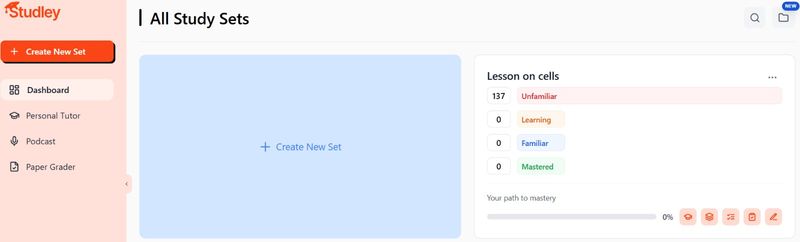
Whether you’re prepping for finals, tackling dense reading, or just trying to get ahead in class, it’s easy to feel overwhelmed by all the content you need to study. Studley makes it easy to break down a burdensome workload into smaller, more manageable chunks. Our innovative AI does this by creating personalized flashcards and other study tools to help you learn the material faster.
Start by uploading your study materials to Studley, and within seconds, you’ll get access to tons of resources to help you understand the content effectively. From there, you can organize the flashcards and quizzes into folders so that you can study the information in a logical order. With Studley, you’ll go from feeling stressed about your upcoming exam to confidently knowing the material in no time.
Tired of Traditional Study Methods? Try Studley AI Instead
If you’ve ever opened a textbook, you know how overwhelming it can be. You might first try to skim the introduction and table of contents to get an idea of the information inside. Then you probably flip to a random chapter, read a few paragraphs, and then get distracted by your phone. Before you know it, an hour has gone by, and you’ve retained nothing.
This is how most people study, and it’s no wonder why so many students dread exams: traditional study methods are tedious and ineffective. Studley AI changes this by turning any type of content from your class notes to YouTube videos into personalized study tools that help you learn. Our method is based on scientific learning techniques, so you can go from hating to studying to enjoying it.
What Makes Studley Different?
There are plenty of study tools out there, so what makes Studley different? For starters, Studley is not just another flashcard app. Sure, we create digital flashcards to help you learn, but that’s just the beginning. With Studley, you’ll also get quizzes, written tests, audio lessons, and tutor-style activities, everything you need to master your study materials quickly. And the best part? They’re all personalized to fit your unique learning style. Instead of stressing out, you can open Studley and let our artificial intelligence do the heavy lifting for you.
How Studley Uses Learning Science to Help You Retain Information
After you upload your materials, Studley AI will organize and create your study tools using proven learning science techniques, such as active recall, spaced repetition, and Bloom’s taxonomy. These methods help improve memory retention so you can study less and remember what you learn for the long haul, instead of just for a test.
Related Reading
- How to Memorize Flashcards
- How to Study Smarter Not Harder
- How to Stay Focused While Studying
- Benefits of Flashcards
- Active Recall Studying
- Virtual Index Cards
- How to Make Index Cards
- How to Use Flash Cards
- How to Memorize a Presentation
- How to Make Effective Flashcards
- Best Spaced Repetition App
- Study Tools for College Student
- Anki vs Quizlet
- Knowt vs Quizlet
- Anki Alternatives
- Quizizz vs Quizlet
- Brainscape vs Quizlet
Get started
Ready to learn smarter with AI?
Join StudleyAI today and experience the future of engaging education.