Download the app

Discover 7 effective Active Recall Studying methods to boost memory retention and learn faster with less review time.
Are you tired of studying for hours only to forget most of what you learned when test day rolls around? You’re not alone. Retaining information for the long haul can feel like an impossible task, especially when you are faced with daunting exams or high-stakes courses. The good news is that research-backed strategies like active recall studying can help you ace your next big test and boost your memory retention for the future.
In this guide, we’ll explore how to effectively implement active recall techniques in your studying routine. You’ll also discover how the best AI flashcard generator, Studley AI’s AI study tool, can help you with this process so you can study smarter and not harder.
Top 7 Active Recall Studying Methods

1. Flashcards
Flashcards stand as one of the most effective tools for active recall. The process is simple: you’re presented with a prompt or question on one side, and you must retrieve the answer from memory before flipping the card. This deliberate act of recalling information strengthens neural connections, making long-term memory retention far more likely. For subjects that rely heavily on visuals, such as biology or geography, incorporating diagrams without labels on the question side can further challenge your recall and deepen your understanding.
To maximize the benefits, it’s best to avoid multiple-choice formats with flashcards, as simply recognizing an answer is much less demanding than generating it yourself. Digital flashcard platforms, such as Studley AI, have made this method even more accessible by offering features like spaced repetition, which ensures that you review information just as you’re about to forget it. This approach not only saves time but also enhances retention, making flashcards a cornerstone of efficient study routines.
2. Transforming Notes Into Questions
Transforming your notes into a series of questions is a powerful way to set yourself up for active learning. When you jot down questions as you take notes, you’re creating built-in prompts that will later require you to retrieve information, rather than passively reviewing your notes. This method encourages deeper engagement with the material, making your study sessions more purposeful.
The Cornell note-taking system is beneficial here, as it provides a dedicated column for questions alongside your main notes. By regularly reviewing and attempting to answer these questions, you practice active recall and reinforce your understanding of the material. This habit turns your notes from a static record into a dynamic study tool, ensuring that you’re constantly challenging your memory and comprehension.
3. Stop and Summarize
Many traditional study habits, like reading textbooks or highlighting notes, are passive and don’t do much to solidify knowledge. To make your study sessions more effective, pause periodically to summarize what you’ve just learned. This act of mentally organizing and expressing information in your own words requires you to retrieve and synthesize key points actively.
One practical way to build this into your routine is by using the summary section in Cornell notes, which prompts you to distill the main ideas after each study session. This reflection not only checks your understanding but also highlights any gaps in your knowledge that need further review. Regularly summarizing material helps move information from short-term to long-term memory, making it a valuable addition to any study strategy.
4. Practice Questions
Practice questions and past exams are invaluable tools for engaging in active recall. By working through these materials, you challenge yourself to retrieve information in a format similar to what you’ll encounter in real assessments. This not only strengthens your memory but also builds confidence and reduces anxiety by familiarizing you with the structure and types of questions you may face. Even when you get answers wrong, the act of attempting to recall and then correcting my mistakes helps cement the correct information in my mind.
Resources for practice questions can often be found in textbooks, online communities, or through your instructors. Many professors provide access to past exams, and some platforms offer crowdsourced problem sets and study notes. If you can’t find materials specific to your course, searching for similar subjects at other institutions can broaden your pool of practice opportunities. The key is not to aim for perfection but to get comfortable with the process of recalling and applying knowledge.
5. Pre-Test Before You Start Revision
Pre-testing is a proactive approach that primes your brain for learning. Before diving into your study session, take a few minutes to test yourself on the material you’re about to review. This could involve answering practice questions, working through problem sets, or simply jotting down everything you remember about the topic. Research shows that this method helps you absorb new information more effectively during subsequent study, as your brain is already alert to gaps in your knowledge.
If you’ve followed the strategy of writing questions in your notes, you’ll find pre-testing even easier. Quickly scan my self-written queries and attempt to answer them from memory. This not only identifies areas that need more attention but also activates my recall pathways, making my actual study session more efficient and targeted.
6. Teach a Friend
Explaining concepts to someone else is one of the most powerful ways to reinforce your understanding. When you teach a friend who is unfamiliar with the subject, you’re forced to break down complex ideas into simpler terms and clarify your thoughts. This process exposes any gaps in your knowledge and encourages you to think critically about the material.
If you don’t have a willing study partner, don’t let that stop you. Imaginary teaching works just as well. Pretend you’re explaining the topic to someone with no background in the subject, and anticipate the kinds of questions they might ask. This exercise requires you to reframe information in new ways, deepening your mastery of the material.
7. Stop Relying on Google
It’s tempting to look up answers online when you’re stuck immediately, but this habit can undermine your ability to remember information long-term. Instead, make a conscious effort to recall the answer yourself before turning to Google or other resources. This practice strengthens your memory and helps you internalize the information more effectively.
When you do need to check your answer, use Google as a tool for verification rather than a shortcut to the solution. Over time, this approach will train your brain to work more efficiently in retrieving information and reduce your reliance on external aids. The more you practice fishing answers out of your memory, the stronger your recall abilities will become.
Related Reading
- 7 Secret Methods for Studying
- What is Memory Retention
- Flashcards Example
- How to Memorize Something Fast
- What is Spaced Repetition Learning
What Is Active Recall?

Active recall is a powerful learning technique that involves actively retrieving information from your memory rather than passively reviewing it. Instead of just rereading notes or watching lectures, you challenge your brain to search for answers, which strengthens your memory and improves long-term retention. For example, answering exam questions, recalling what you had for lunch yesterday, or telling a story by remembering key details are all forms of active recall. This process triggers the "testing effect," a phenomenon in which retrieving information helps embed it more deeply in long-term memory.
Active recall differs from passive study methods, such as highlighting or rereading, because it forces your brain to work harder, thereby strengthening the memory connections. This makes it easier to recall information later and helps identify knowledge gaps that require further attention. Practical ways to utilize active recall include using flashcards, practicing past exam questions, teaching the material to someone else (known as the Feynman technique), summarizing information in your own words, or doing "blurting," where you quickly write down everything you remember about a topic.
Studley AI fits naturally into this conversation as a digital tool designed to enhance active recall. It helps students create and engage with personalized quizzes and flashcards, making the retrieval practice more interactive and efficient. By integrating AI, Studley AI can adapt to your learning pace and focus on areas where you need the most practice, maximizing the benefits of active recall..
Studley: Your AI-Powered Study Buddy
Stop Cramming. Start Learning smarter, faster, and more effectively. Studley AI isn’t just another study app; it’s your all-in-one AI-powered learning companion. Whether you’re prepping for exams, struggling with dense readings, or just trying to stay ahead, Studley takes the stress out of studying. Upload your class notes, YouTube videos, textbooks, or articles, and get instant, editable flashcards, quizzes, tutor-style lessons, written tests, fill-in-the-blank activities, and even personalized audio lessons. No setup. No wasted time. Just tools that help you learn faster and retain more. Forget overpriced tutors or endless scrolling through confusing resources.
Studley AI leverages proven learning science, including Active Recall, Bloom’s Taxonomy, and the Feynman Technique, to transform any content into a personalized study experience that aligns with the way your brain learns. You can try everything for free, no credit card required. But if you’re serious about school, upgrading gets you unlimited quizzes, lessons, paper feedback, audio learning, and more. Wherever you are, at your desk, on the bus, or in bed, Studley AI makes it ridiculously easy to learn. Stop Cramming. Study Smarter with our AI study tool for Free Today!
Related Reading
- How to Memorize Flashcards
- How to Study Smarter Not Harder
- How to Stay Focused While Studying
- Benefits of Flashcards
- Virtual Index Cards
- How to Make Index Cards
- How to Use Flash Cards
- How to Memorize a Presentation
Stop Cramming. Study Smarter with Studley for Free Today!
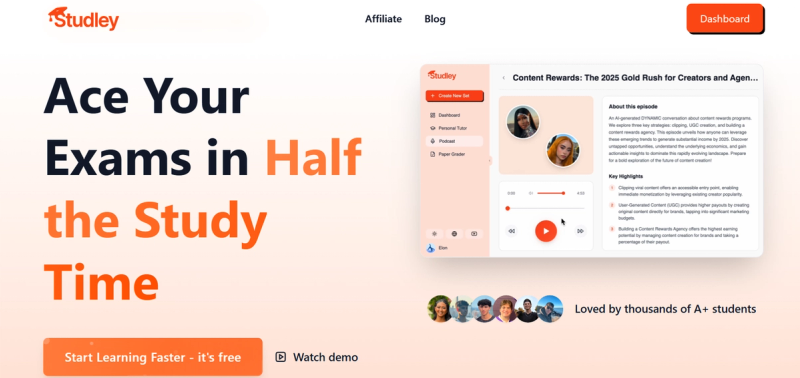
Studley AI isn’t just another study app; it’s your all-in-one AI-powered learning companion. Whether you’re prepping for exams, struggling with dense readings, or just trying to stay ahead, Studley takes the stress out of studying. Upload your class notes, YouTube videos, textbooks, or articles, and get instant, editable flashcards, quizzes, tutor-style lessons, written tests, fill-in-the-blank activities, and even personalized audio lessons. No setup. No wasted time. Just tools that help you learn faster and retain more. Forget overpriced tutors or endless scrolling through confusing resources.
Study Smarter With Active Recall
Studley AI utilizes proven learning sciences, such as Active Recall, Bloom’s Taxonomy, and the Feynman Technique, to transform any content into a personalized study experience that aligns with the way your brain works. You can try everything for free, no credit card required. But if you’re serious about school, upgrading gets you unlimited quizzes, lessons, paper feedback, audio learning, and more. Wherever you are, at your desk, on the bus, or in bed, Studley AI makes it ridiculously easy to learn. Stop cramming. Study smarter with our AI study tool for free today!
Related Reading
- How to Make Effective Flashcards
- Best Spaced Repetition App
- Study Tools for College Student
- Anki vs Quizlet
- Knowt vs Quizlet
- Anki Alternatives
- Quizizz vs Quizlet
- Brainscape vs Quizlet
Get started
Ready to learn smarter with AI?
Join StudleyAI today and experience the future of engaging education.